
Good General EMC Design Guidelines
Here are four general design guidelines that are often overlooked, even though they can be among the easiest to implement early in the design process.
Design Guideline #1: Minimize the Loop Areas Associated with High-Frequency Power and Signal Currents.
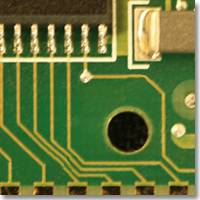
This simple rule is on nearly everybody's list of EMC guidelines, and it's generally good advice. Pay attention to where the signal currents will flow. Digital circuit designers like to think of signals in terms of their voltage. Signal integrity and EMC engineers must think of signals in terms of their current. It's not ALL about the space. It's about controlling both the fields and the currents.
There are two things that every good circuit designer should know about signal currents.
- Signal currents always return to their source (i.e., steady state current paths are always loops)
- Signal currents take the path(s) of least impedance.
At megahertz frequencies and higher, signal current paths are relatively easy to identify. This is because the path of least impedance at high frequencies is generally the path of least inductance. This is generally the path that minimizes the loop area. Currents return as close as possible to the path of the outgoing current. At low frequencies (generally kHz frequencies and below), the path of least impedance tends to be the path(s) of least resistance. Low-frequency currents are more difficult to trace, since they will spread out. Significant current return paths may be relatively distant from the outgoing current path.
Minimizing loop areas helps to minimize the opportunities for unwanted coupling to other circuits or structures. Two things to keep in mind though:
- Radiation is NOT proportional to loop area. Long traces and cables can carry high-frequency currents without producing significant radiated emissions when they are properly designed.
- Radiation is NOT proportional to near-field field strengths. Preventing unwanted radiated emissions is all about maintaining control of the signal power and not driving the structures that make relatively efficient unintentional antennas.
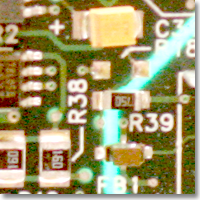
Design Guideline #2: Don't Split, Gap or Cut the Signal Return Plane
Just don't do it! Recognize the difference between ground and current return. Sometimes grounds are isolated from current returns for safety reasons. Sometimes, current returns are isolated for safety reasons or to prevent common-impedance coupling. All of these situations can be handled safely and effectively without ever gapping a circuit board's return plane. If you are convinced that a gap is necessary to prevent a coupling problem, seek advice from an expert. Don't rely on design guidelines or application notes, and don't try to implement a scheme that "worked" in someone else's "similar" design.
Design Guideline #3: Don't Locate High-Speed Circuitry Between Connectors
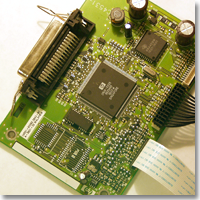
Among board designs that we have reviewed or evaluated in our lab, this is one of the most common problems we've encountered. Many times, simple board designs that should have had no trouble at all meeting EMC requirements at no additional cost or effort wind up being heavily shielded and filtered because they violated this simple rule.
Why is the location of connectors so important? At frequencies below a few hundred megahertz, wavelengths are on the order of a meter or longer. Any possible antennas on the printed circuit board itself tend to be electrically small and therefore inefficient. However, cables or other devices connected to a board can serve as relatively efficient antennas.
Signal currents flowing on traces and returning through solid planes result in small voltage differences between any two points on the plane. These voltage differences are generally proportional to the current flowing in the plane. When all connectors are placed along one edge of a board, the voltage between them tends to be negligible. However, high-speed circuitry located between connectors can easily develop potential differences of a few millivolts or greater between the connectors. These voltages can drive currents onto attached cables, causing the product to exceed radiated emissions requirements.
If you have a product that MUST locate high-speed circuitry between external connections, this can be effectively handled by providing a metal chassis that makes a good low-inductance connection to the circuit board's EMC ground near both connector locations. But don't rely on this unless you have to. Putting all of the external connections on the same edge of the board makes it much easier to ensure compliance with both emissions and immunity requirements.
Design Guideline #4: Control Signal Transition Times
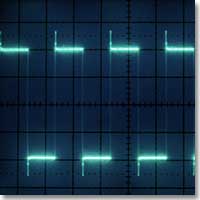
A board operating with a clock speed of 100 MHz should never fail to meet a radiated emissions requirement at 2 GHz. A well-formed digital signal will have a significant amount of power in the lower harmonic frequencies, but not so much power in the upper harmonics. Power in the upper harmonic frequencies is best controlled by slowing the transition times in digital signals. While excessively long transition times can cause signal integrity and thermal problems, an engineering compromise must be reached between these competing requirements. A transition time that is approximately 20% of a bit period results in a reasonably good-looking waveform, while minimizing problems due to crosstalk and radiated emissions. Depending on the application, transition times may need to be more or less than 20% of the bit period; transition times should not be left to chance.
There are three common methods for controlling rise and fall times in digital logic.
- Use a logic family with a controlled slew-rate.
- Put a resistor in series with a device's output (for capacitive loads) - don't use ferrites.
- Put a capacitor in parallel with a device's output (for matched loads) - not recommended.
The first choice, controlled slew-rate logic, is often the most effective option, especially when driving a matched termination. However, the majority of the logic circuits on most well-designed boards will have a capacitive termination. Using a series resistor to control the risetime of these circuits gives the designer more control and usually costs less. Capacitors can actually increase the amount of high-frequency current drawn by the source device, and in most cases are not an appropriate choice for transition time control.
Note that it is never a good idea to try to slow down or filter a single-ended signal by impeding the flow of current in the return path. For example, one should never intentionally route a low-speed trace over a gap in a return plane or put a ferrite on a ground in an attempt to filter out the high-frequency noise.