
EMC Question of the Week: October 12, 2026
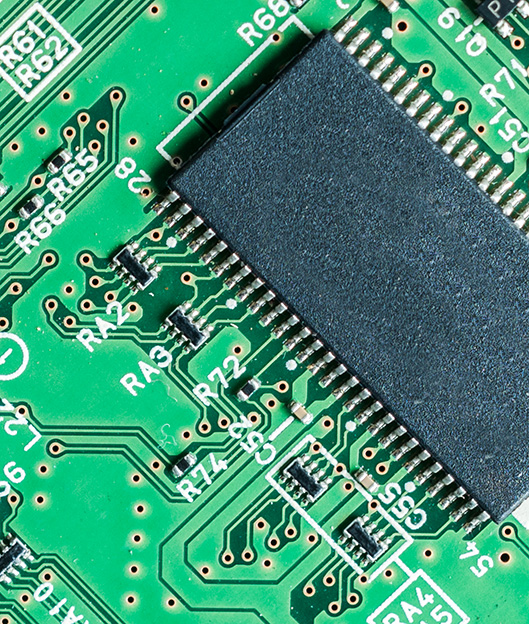
1-kΩ resistors in series with the low-speed inputs of a microprocessor can help a product meet
- radiated emissions requirements
- ESD requirements
- both of the above
- none of the above
Answer
The best answer is “c.” Resistors in series with low-speed CMOS inputs to a microprocessor can serve two functions. They can help to meet radiated emissions requirements by preventing the noise currents generated within the microprocessor from coming out on the input traces. They can help to meet electrostatic discharge immunity requirements by slowing the response time of the input, which prevents noise transients lasting less than a few nanoseconds from triggering the input.
Relatively strong harmonics of a microprocessor's internal clocking frequency are often observed on input pins that are nominally low-speed or DC. The traces connected to these pins can carry clock harmonic currents out onto the board where they may ultimately couple to structures that become the unintentional antennas responsible for radiated emissions. A series 1-kΩ resistor on an input prevents these currents from escaping the processor (at least on that input).
Field-coupled ESD transients with sufficient amplitude to toggle a digital input commonly appear on all exposed circuit board traces in the general vicinity of the discharge. A normal CMOS input with about 5 pF of input capacitance will respond to transients lasting less than 1 nanosecond. Adding a resistor in series with these inputs slows the response time of the input. For example, a 1-kΩ resistor and a 5 pF capacitance have a time constant greater than 5 nanoseconds. With the resistor in place, most ESD field-coupled transients are incapable of toggling the input.
Not all low-speed microprocessor inputs benefit from a series resistor. For emissions, resistors are only necessary for those inputs capable of coupling the noise to other traces or components that can carry it off the board.
Have a comment or question regarding this solution? We'd like to hear from you. Email us at