
EMC Question of the Week: October 5, 2026
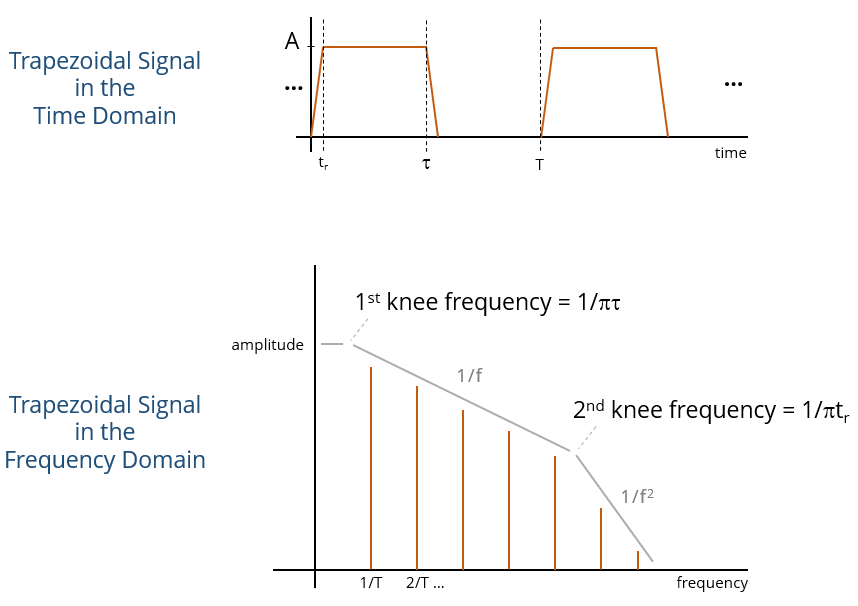
A 5-MHz square wave has 1-ns transition times and a peak-to-peak amplitude of 1.0 volt. What is the amplitude of the harmonic at 125 MHz as measured on a spectrum analyzer?
- < 5 mV
- 18 mV
- 40 mV
- > 100 mV
Answer
The best answer is “b.” The 1-ns transition time is typical of CMOS clock sources driving light loads. It corresponds to a second knee frequency (1/πtr) of 318 MHz. So, at 125 MHz, the harmonic amplitudes are still falling at a rate of 20 dB/decade. 125 MHz is the 25th harmonic of 5 MHz. The rms amplitude of the first harmonic is always 0.45 times the peak-to-peak voltage of the square wave. The amplitude of the 25th harmonic is 25 times smaller. Therefore, the amplitude of the harmonic at 125 MHz is 1.0 volts x 0.45/25 = 18 mV. This is 85 dB(μV) or -22 dBm.
Note that a spectrum analyzer always displays the rms amplitude. Applying an FFT to the time domain signal always displays the peak amplitude. For narrow-band harmonics, which are essentially sign waves, the ratio of the peak to rms amplitudes is sqrt(2) or 3 dB.
A 1-ns transition time is much faster than necessary for a 5-MHz digital signal. Slowing the transition time to 20 ns would reduce the amplitude of the harmonic at 125 MHz to 2.3 mV (18 dB lower).
Have a comment or question regarding this solution? We'd like to hear from you. Email us at