
EMC Question of the Week: September 21, 2026
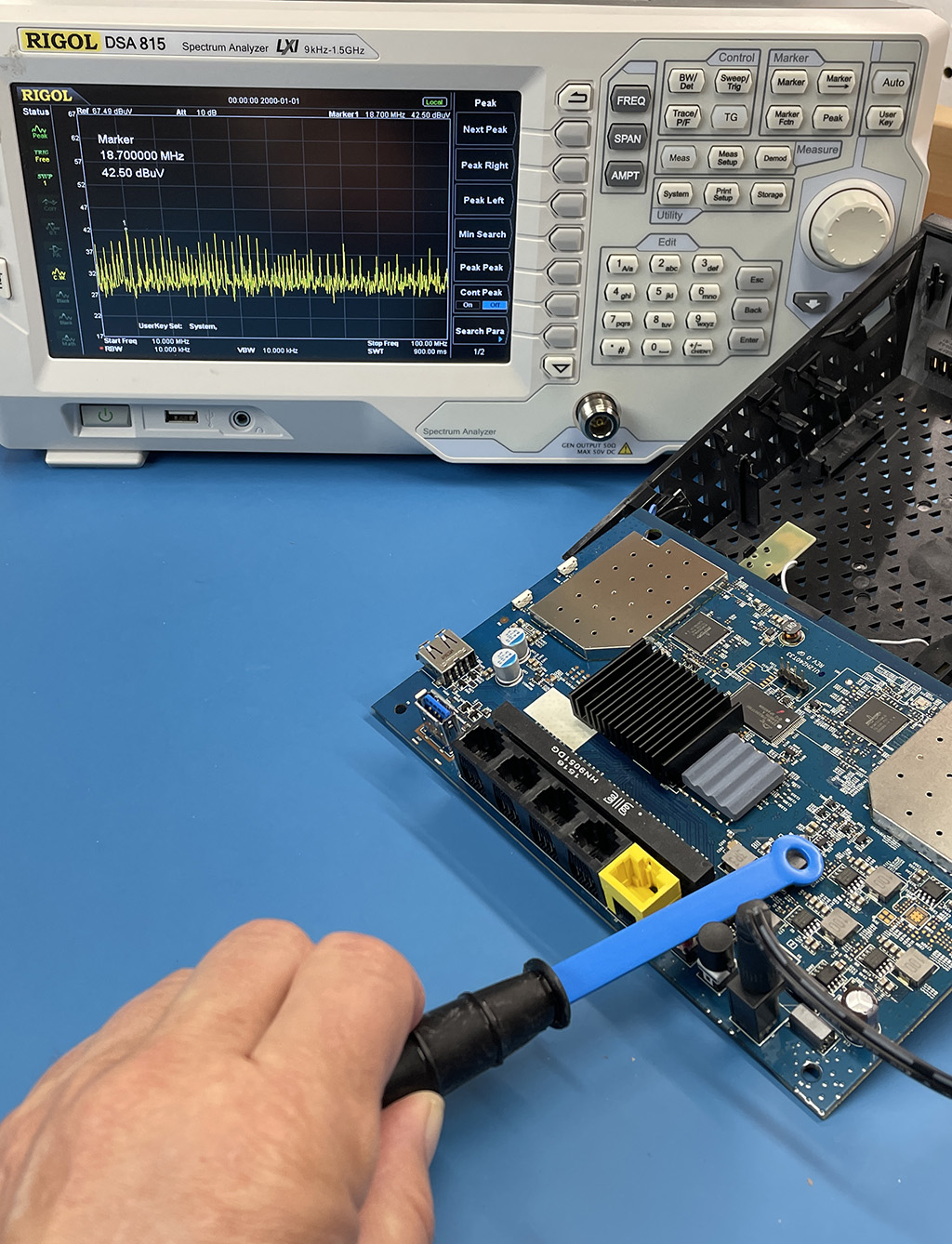
The near-field probe measurement depicted in the photo shows peaks spaced approximately 1.9 MHz apart. Between 30 and 50 MHz, the amplitude of these peaks is approximately 40 dB(μV). When the probe is positioned at any other location, the peaks are much lower. We can conclude that
- this product is likely to fail to meet its radiated emissions requirement
- this product is likely to meet its radiated emissions requirement (30-50 MHz)
- there is a relatively strong 1.9-MHz signal voltage at that location
- there is a relatively strong 1.9-MHz signal current at that location
Answer
The best answer is “d.” The probe in the photo is a near-magnetic-field probe. Magnetic fields are generated by currents in component pins and traces. These currents are strong in this location compared to other locations on the board. In this example, the voltage detected is proportional to the magnetic field intensity times the frequency. The harmonics of a digital clock signal with a fast transition time fall off proportional to frequency. As a result, the detected voltage at each harmonic frequency is approximately the same.
Generally, no conclusions can be drawn regarding the likelihood of meeting a radiated emissions requirement from the amplitude of the near fields. This is particularly true at frequencies below a few hundred megahertz. At these frequencies, failing an emissions requirement usually requires driving structures off the board that act as an efficient unintentional antenna. Without a good antenna, very strong near-fields do not necessarily produce significant far fields. With a good antenna, boards with near fields that are barely detectable can produce far-field emissions that are well above the specification.
Near-field measurements, including the surface scans that produce visual maps of the fields above the surface of a board, are great for locating significant voltages and current paths at any given frequency. This can be very helpful for troubleshooting problems and "following the current" in a printed circuit board design. However, "hotspots" detected during a near-field scan are normal. They indicate locally strong currents or voltages. They cannot directly tell us anything about the likelihood that a product will meet its EMC requirements.
Have a comment or question regarding this solution? We'd like to hear from you. Email us at