
EMC Question of the Week: July 13, 2026
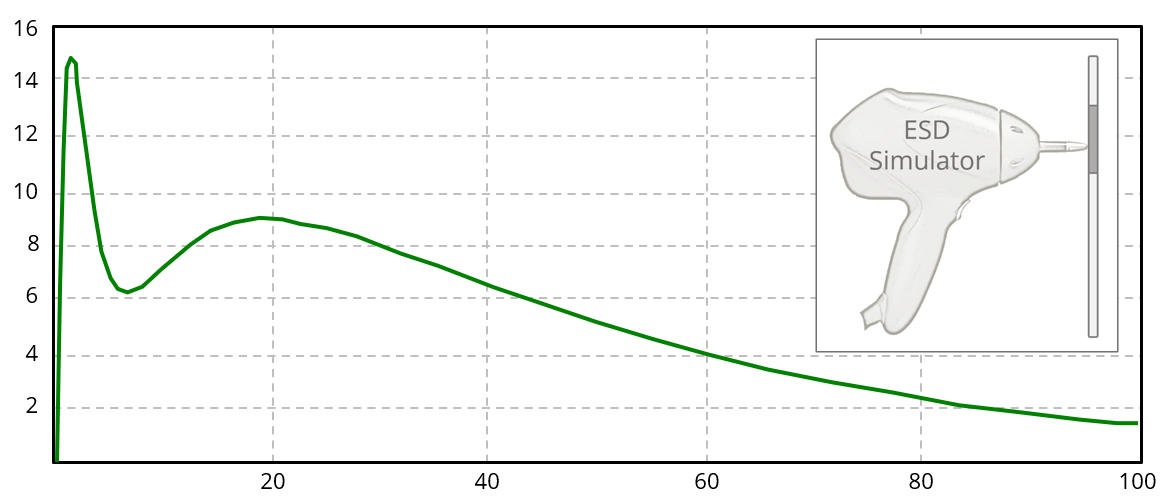
The initial spike in the current from an ESD simulator discharged into a calibration target is primarily due to the
- simulator's internal capacitor
- simulator's switch capacitance
- simulator's self-capacitance
- target's center plate capacitance
Answer
The best answer is “c.” During the first couple of nanoseconds after the simulator is triggered, relatively little charge can be pulled from the simulator's internal capacitor due to the large inductance of its connection through the ground strap. On the other hand, charge stored on the external metal surfaces of the simulator immediately begins to flow into the target. The self-capacitance is small (~20 pF) compared to the simulator's internal capacitor (~250 pF), but the path inductance is much smaller. The rise and fall times associated with draining the charge from the self-capacitance are very short (~1 ns), but the total energy in this part of the discharge is relatively small.
The simulator switch capacitance is very small and plays no significant role in shaping the current waveform. The center plate of the target is small and accepts charge very quickly, but the current associated with charging that plate is not measured. The measured waveform is the voltage dropped across the resistance as the charge moves from the center plate of the target to the large metal surface surrounding the target.
Have a comment or question regarding this solution? We'd like to hear from you. Email us at