
EMC Question of the Week: June 29, 2026
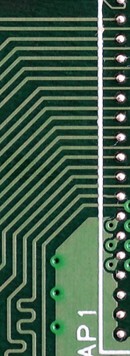
A single-ended 1-Gbps digital signal is routed across a circuit board (10 cm) on a microstrip trace that is 0.25 mm above the return plane. To meet EMC and signal integrity requirements, this signal trace should normally have a
- balanced termination
- coplanar ground
- controlled impedance
- all of the above
Answer
The best answer is “c.” For signal integrity reasons, the transition times of a 1-Gbps signal are normally on the order of 100 ps. Using a controlled impedance trace with a matched termination is essential. The signal is single ended, so the termination resistance should be connected to the return plane, not balanced.
Coplanar ground is often advocated on social media sites for high-speed traces. However, peer-reviewed studies have consistently shown that coplanar ground is ineffective when there is a return plane 0.25 mm or less below the signal traces. In this environment, coplanar ground does not significantly reduce the crosstalk. It does, however, make it more difficult to terminate the signal and can become a source of unwanted resonances.
Peer-reviewed publications that demonstrate a benefit associated with coplanar ground and/or guard traces invariably draw those conclusions based on measurements that have a return plane approximately 1 mm below the signal trace, or models with unrealizable spacing and connections. Real applications that route Gbps signals 0.25 mm above a plane can achieve suitably low crosstalk levels more reliably by simply providing adequate spacing between the source and victim traces.
Have a comment or question regarding this solution? We'd like to hear from you. Email us at