
EMC Question of the Week: June 1, 2026
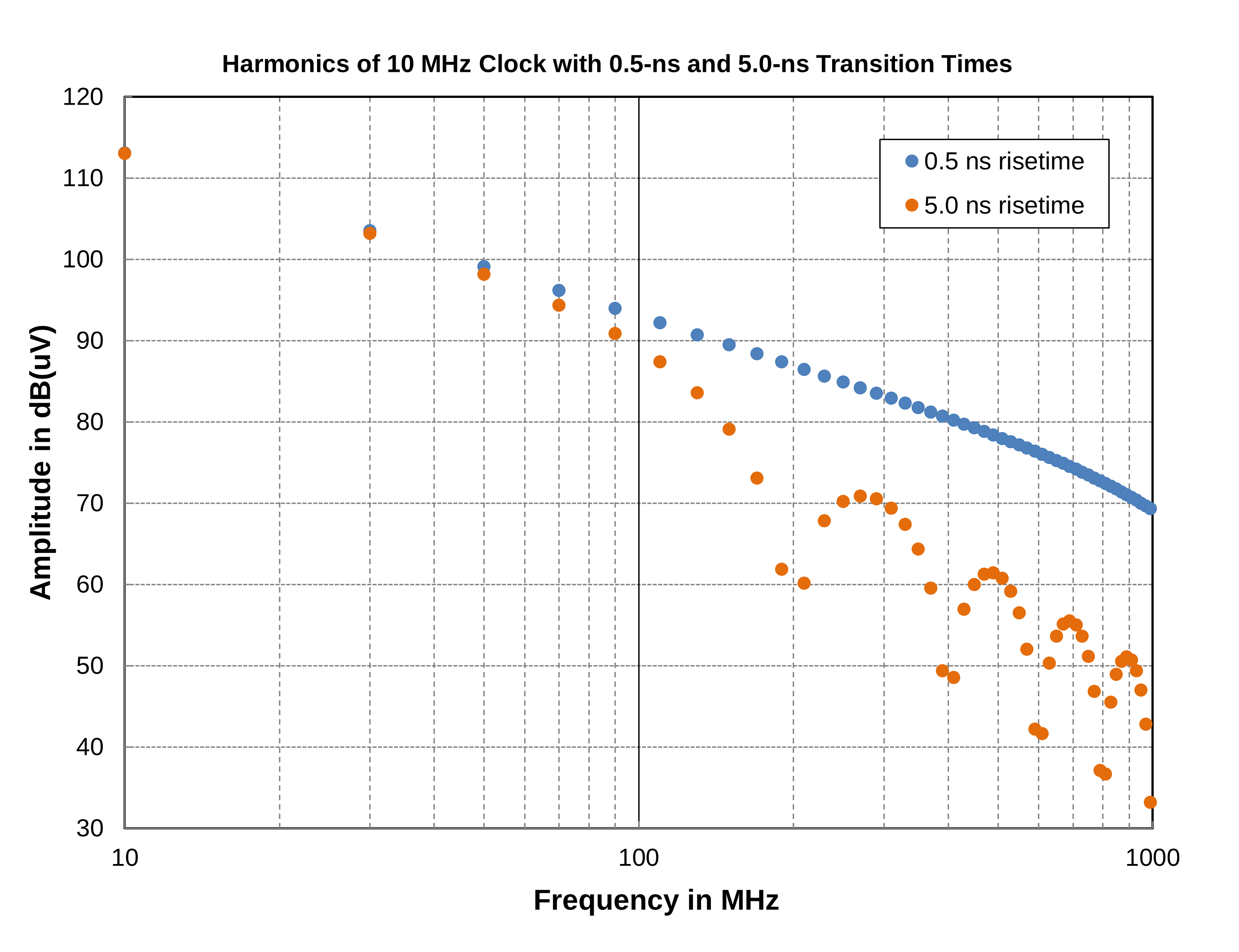
The figure plots the amplitude of the harmonics for a 1-Vpp 10-MHz trapezoidal waveform with 0.5-ns and 5-ns transition times. With a 5-ns transition time, there is a clear (sin x)/x shape with nulls at multiples of 200 MHz. The location of these nulls is determined by the
- transition time
- duty cycle
- fundamental frequency
- rounding error
Answer
The best answer is “a.” The nulls in this figure occur at frequencies equal to n/tr, where n is an integer and tr is the transition time. Note that the waveform with the 0.5-ns transition time also has nulls, but the first one occurs at 2 GHz, so it doesn't appear on this plot.
If the transition time were zero, the harmonics would fall off as 1/f indefinitely. On this plot, they would have virtually the same amplitude as the 0.5-ns waveform harmonics without the slight dip at frequencies above 600 MHz.
The waveforms whose harmonics are shown in the figure have a 50% duty cycle. If the duty cycle were anything other than 50%, we would see another (sin x)/x pattern in the harmonics. This one would have nulls at frequencies equal to n/τ, where τ is the on-time or off-time (whichever is shorter). These (sin x)/x shapes are apparent from the expression used to calculate the harmonics of a trapezoidal waveform,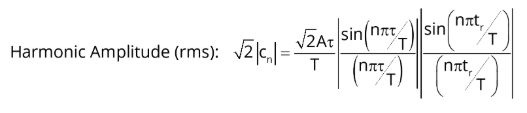 .
.
The exact harmonic amplitudes shown by the orange dots in the figure could also have been produced by a 10-Vpp, 10-MHz trapezoidal waveform with a very fast transition time and a 5% or 95% duty cycle.
Note that the fundamental frequency does not affect the location of the nulls. However, the fundamental frequency does affect the location of the harmonics. Changes in the fundamental frequency determine which harmonics are located at or near a null.
Have a comment or question regarding this solution? We'd like to hear from you. Email us at