
EMC Question of the Week: May 18, 2026
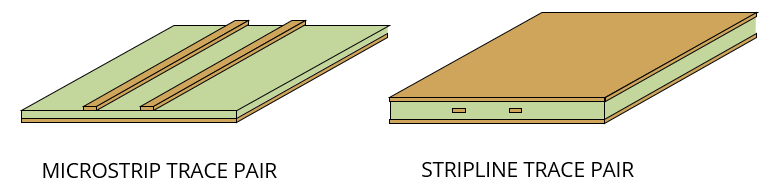
One advantage of routing high-speed differential signals on microstrip trace pairs as opposed to stripline trace pairs is that microstrip trace pairs generally
- radiate less
- take up less space
- have better balance
- have lower loss
Answer
The best answer is “d.” For a given layer spacing and characteristic impedance, a microstrip trace is wider than a stripline trace. This helps to reduce conductor loss. Dielectric losses can also be lower, because part of the field propagates in the space outside of the dielectric. Another feature of microstrip traces that can be important is that the velocity of propagation is higher, which reduces the propagation delay.
Radiation to the far-field is rarely an issue with either microstrip or stripline trace pairs. In theory though, striplines radiate less than microstrip traces.
Microstrip traces are wider for a given characteristic impedance and require greater trace-to-trace spacing from other signal traces to control crosstalk. Therefore, they generally take up more space on a given layer. Of course, one could argue that a stripline requires two plane layers and therefore in some applications monopolizes more of the available routing area.
For differential signals, both microstrip and stripline trace pairs are balanced [i.e. each trace has the same impedance to the plane(s)]. For common-mode propagation, both microstrip and stripline trace pairs are unbalanced. For common-mode propagation, the microstrip trace pair is slightly more balanced than the stripline pair, but that is usually a disadvantage not an advantage (when it matters at all).
Have a comment or question regarding this solution? We'd like to hear from you. Email us at