
EMC Question of the Week: May 4, 2026
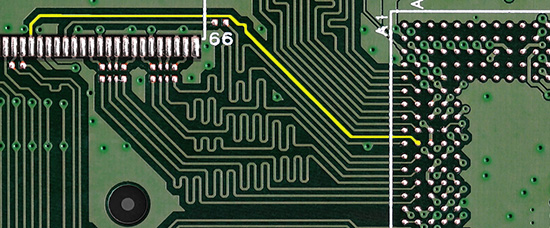
If a microstrip trace carrying a digital signal extends a distance that exceeds its "critical length," it's generally necessary to
- slow the signal transition time
- provide a matched termination
- either (a.) or (b.)
- none of the above
Answer
The best answer is “c.” The "critical length" of a signal trace is generally defined as the distance corresponding to a propagation delay of 1/2 to 1/6 of the signal transition time. For example, a 1-Mbps signal that has a 1-ns transition time propagating on a typical microstrip trace (FR-4 dielectric) has a critical length of about 3 to 8 cm. At greater distances, the signal fully transitions before the load impedance is known. This can result in significant ringing and inter-symbol interference.
Providing a controlled impedance trace and matched termination is one way to prevent this ringing. However, for signal rates that are tens of Mbps or slower it is usually better to slow the transition time. In this example, slowing the transition time to 40 ns would extend the critical length by a factor of 40. The same signal could travel 1 to 3 meters without any matching requirement.
Controlled impedance traces and matched terminations are often necessary for high-speed digital signals that travel significant distances. But controlled impedances traces add cost and complexity to a board design, and matched terminations can greatly increase the circuit's power dissipation relative to capacitive CMOS device inputs.
Depending on the application, some traces that exceed the critical length may not require matching. Also, some traces that are shorter than the critical length may require matching for reasons unrelated to ringing (e.g. providing an appropriate load for the driver). Like most design guidelines, the concept of a critical length helps to direct attention to potential issues. However, like virtually all EMC design guidelines, it should not be strictly adhered to without understanding what it means and why it exists in the first place.
Have a comment or question regarding this solution? We'd like to hear from you. Email us at