
EMC Question of the Week: March 2, 2026
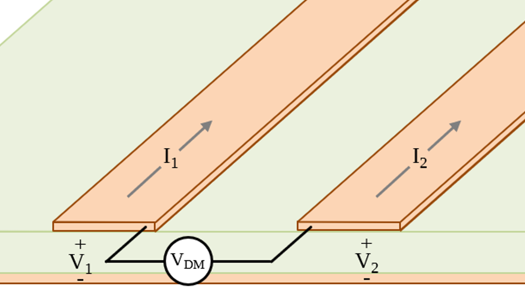
For a differential signal propagating on a balanced pair of microstrip traces, what is the difference between differential-mode propagation and odd-mode propagation?
- differential-mode is undefined
- odd-mode is undefined
- a factor of 2
- there is no difference
Answer
The best answer is “d.” For identical traces, differential-mode propagation is the same as odd-mode propagation. In both cases, one trace is driven with a positive voltage and the other with an equal-magnitude negative voltage relative to the plane. Common-mode (or even-mode) propagation occurs when both traces are driven with the same voltage relative to the plane.
If you chose "c.", you were probably thinking of the way that the odd-mode impedance is defined. The odd-mode impedance is the amount of termination resistance that would be applied between each trace and ground in order to match the differential-mode (odd-mode) propagation. For a balanced trace pair, the odd-mode impedance is always one-half the differential-mode characteristic impedance (ZODD1 = ZODD2 = ZDM/2).
Differential-mode and common-mode are well-defined propagation modes with well-defined characteristic impedances. This is true even if the signal carrying conductors have different geometries. On the other hand, the odd-mode impedance and even-mode impedance are only well-defined when the two signal carrying conductors have the same impedance to a common ground conductor. In this case, the even-mode impedance is always twice the common-mode impedance (ZEVEN1 = ZEVEN2 = 2*ZCM).
Have a comment or question regarding this solution? We'd like to hear from you. Email us at