
Chapter 11 Exercise: Pre-compliance Emissions Measurements
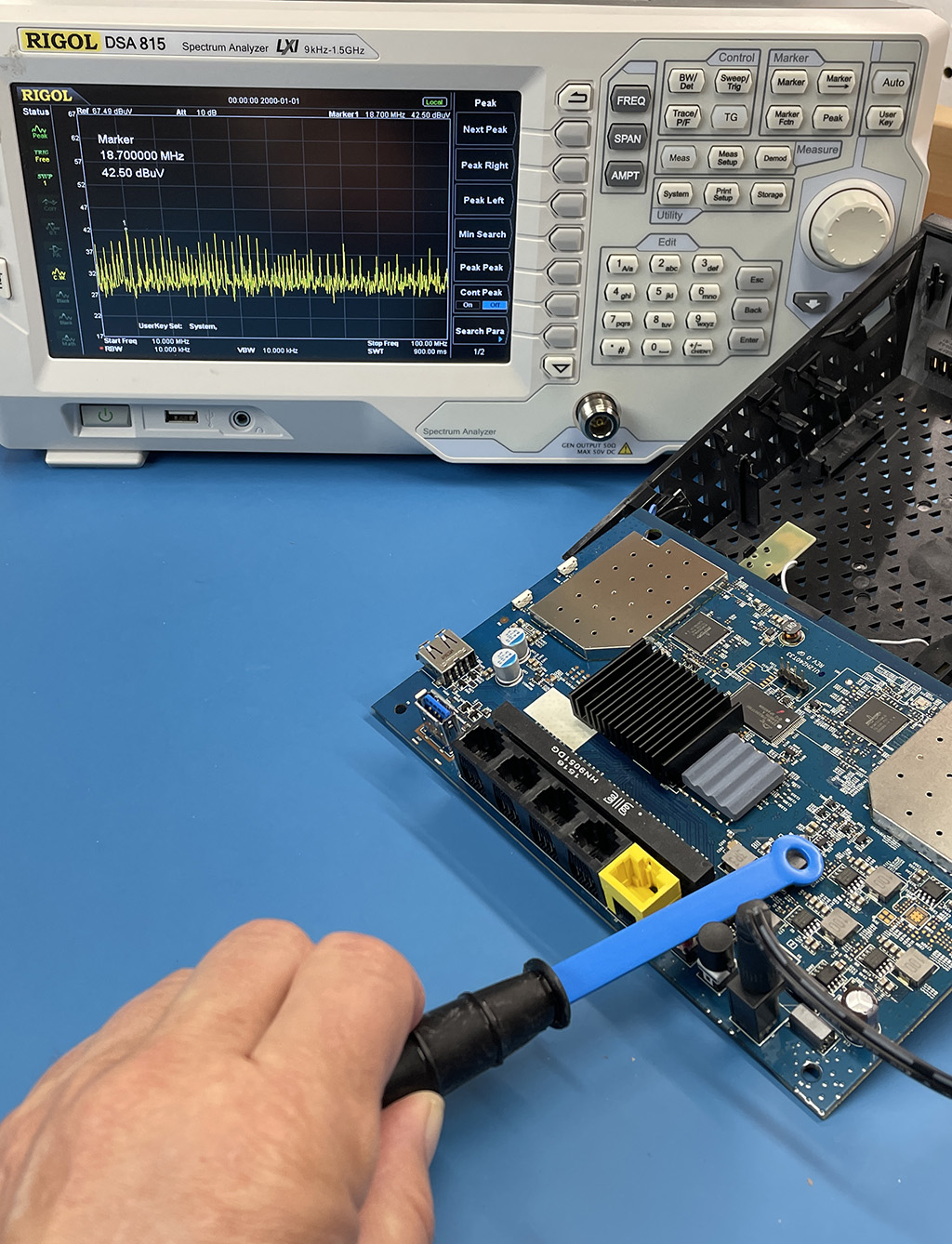
This lab gives students some experience with the tools used to make basic pre-compliance emissions tests.
Preparation: This lab requires a product with an exposed circuit board that is powered up. For safety reasons, the circuit board should be powered by low-voltage DC (e.g., from a wall brick). Obsolete computing devices including laptops, printers, and routers are excellent candidates for this exercise.
Equipment Required:
- product with an exposed circuit board
- spectrum analyzer (10 MHz - 1 GHz)
- selection of near-field probes
- RF current probe (and pre-amplifier if necessary)
Procedure:
Step 1: Expose and power up the circuit board of a commercial electronic device. What radiated emissions requirements is the device required to meet? Does it contain any intentional transmitters and/or receivers?
Step 2: Use an electric near-field probe connected to a spectrum analyzer (120 kHz resolution bandwidth) to look for “hotspots.” Reduce the resolution bandwidth and frequency span as necessary to resolve peaks in the spectrum. Record peak frequencies and try to determine which components/signals are responsible for the various peaks. Can you identify power converter switch nodes? Can you identify high-frequency decoupling capacitors? What can you say about the amplitude and direction of the electric field strengths being measured?
Step 3: Repeat the previous step using a magnetic near-field probe and answer the same questions.
Step 4: Measure the peak currents observed on the attached cables. Do any of them exceed 5 μA at any given frequency? Can you tell which sources on the board are responsible for these currents?
Step 5: If this device was failing to meet a radiated emissions requirement, what steps would you try taking to reduce the emissions?
Notes:
Students should be encouraged to adjust the settings on the spectrum analyzer to reduce the noise floor or resolve individual peaks.